The AI Readiness Objectives
Towards Sufficiency in National AI Security Strategies
By
Gwyn Glasser
, Elliot McKernon
Authors


Originally Published
Executive Summary
The AI Readiness Objectives (AROs) are a set of 7 broad, aspirational goals that represent the objectives of all or most AI security interventions. We propose that governments who can define, achieve and maintain adequacy in these 7 areas will be sufficiently prepared to securely harness the most powerful AI systems into the future.
The Challenge: AI capabilities are improving quickly, with massive security and economic implications. The costs of early policy failures may be unacceptably high, and governments cannot assume they will have time to adapt to AI through slow, iterative processes. At the same time, despite the large number of expert recommendations on how to govern AI, governments lack guidance on what strategic configurations of interventions will sufficiently prevent intolerable risks to their economic and security interests.
Our Approach: We present the AROs in a concise framework, ordered from upstream to downstream to support prioritization, with links to key resources on expert-proposed interventions for each objective. The framework helps clarify what needs to happen to prepare for the future, in what sequence, and how experts propose achieving it.
While AROs are useful for a range of AI security actors, this report and the current framework are primarily intended for researchers and other operators developing strategies to support and inform policymakers. This work is already enabling further research at Convergence Analysis (see our forthcoming work).
Methodology: AROs were created through a review of the interventions presented in 83 sources on governing advanced AI; ~400 interventions were harmonised and grouped by hand, incorporating feedback from 33 experts at leading think tanks, US, UK and EU Government bodies, and frontier AI lab staff. The AROs Framework is the subject of ongoing expert consultations, and remains a living document. See Methodology for more details.
This report introduces the AROs Framework, the problem it addresses, and our design choices. Future AI Readiness Case Studies will apply it to assess the preparedness of specific jurisdictions and identify targeted policy recommendations.
The Challenge: Achieving AI Readiness
AI Readiness here means a sufficient combination of interventions to prevent or mitigate intolerable risks to national security, the economy, and the public. In practice, these interventions may depend on the risks and risk tolerance of each jurisdiction. As AI capabilities advance, security measures will need to keep advancing in response. AI readiness must therefore be highly responsive to the changing field.
AI capabilities are improving quickly, with massive security and economic implications. The costs of early policy failures may be unacceptably high, and governments cannot assume they will have time to adapt to AI through slow, iterative processes.
The challenges involved in preparing for AI are highly complex: governments must harness the opportunities of AI innovation while navigating a matrix of threat actors and attack vectors. Threats include CBRN incidents, sophisticated cyber, influence and military operations, extreme economic disruption, and AI control failures. Further complexity arises from interactions between interventions: some interventions may depend on others (e.g. international agreements may require development of verification mechanisms), while others may involve natural tensions (e.g. nationalizing frontier labs may secure democratic control, but may also centralise authority to deploy AI, harming innovation).
Governments need to sequence and combine many interventions quickly to avoid intolerable risks. But getting it right on the first try will require having clear sets of targets. Governments will require clarity on:
(1) Concrete objectives for AI Readiness,
(2) The interventions and policy measures that can achieve those objectives, and
(3) How those measures should be combined and sequenced within a greater AI strategy.
The AROs Framework is the first step in creating clarity in these areas. The Framework: (1) Highlights the 7 areas in which concrete targets must be set; (2) provides resources on the relevant policy measures and interventions that exist in each area; (3) splits areas into upstream and downstream objectives to support reasoning about project prioritisation across areas. Additional forthcoming AROs products are building on the framework to provide precise recommendations for legislators: (1) Case studies will propose readiness targets for the USA and highlight the relevant expert recommendations. Subsequently, (3) we plan to produce a tool that maps interactions between interventions in detail, giving more granular insights on the trade-offs involved with different combinations of interventions.
The AI Readiness Objectives (AROs) Framework
The AI Readiness Objectives (AROs) are a set of 7 broad, aspirational goals that represent the objectives of all or most AI security interventions. We propose that governments that can define, achieve and maintain adequacy in these 7 areas will be sufficiently prepared to securely harness the most powerful AI systems into the future.
The AROs are presented within the AROs Framework: The 7 AROs are sorted into 3 Pillars, ordered from upstream to downstream. Each Objective covers a range of Interventions that contribute to achieving it. For each type of Intervention, we provide a list of 3-5 touchstone resources that describe the intervention, and where they exist, concrete recommendations on how to implement it.
We recommend exploring the framework using the interactive online version. There you can click on any Objective to reveal its relevant Interventions and navigate to associated resources from the AROs resource list.
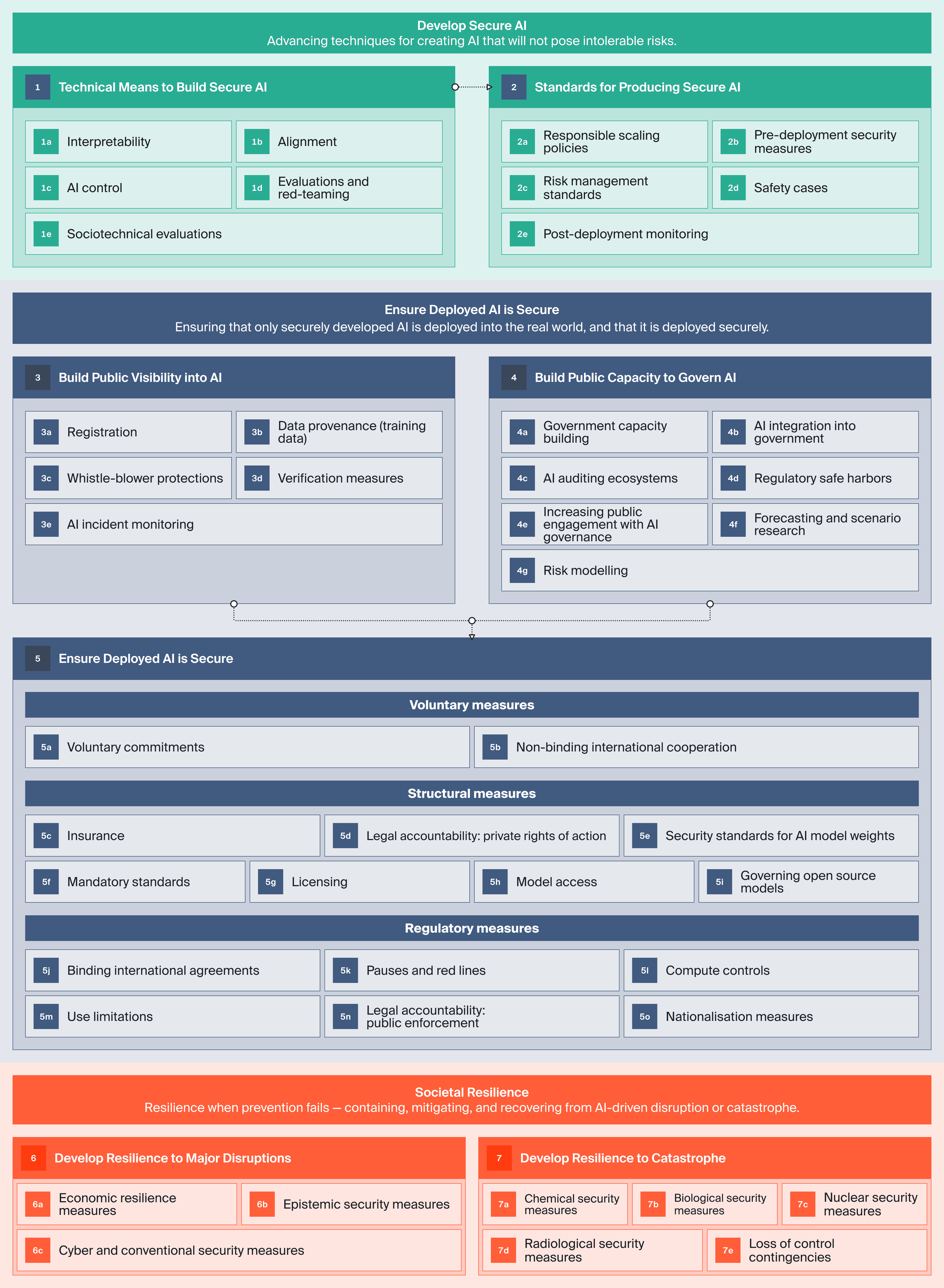
You can view the keystone resources for each intervention and definitions for each Pillar, Objective and Intervention here: AROs Resource List
Note
The AROs aim to include all well-documented AI security interventions. There may be specific interventions that are not included, either because they were not well-documented at the time of publication, or were not captured by our methodology. However, we expect the existing Pillars and Objectives to be compatible with new interventions as they enter the AI security discourse.
Addendum: AI Innovation Priorities
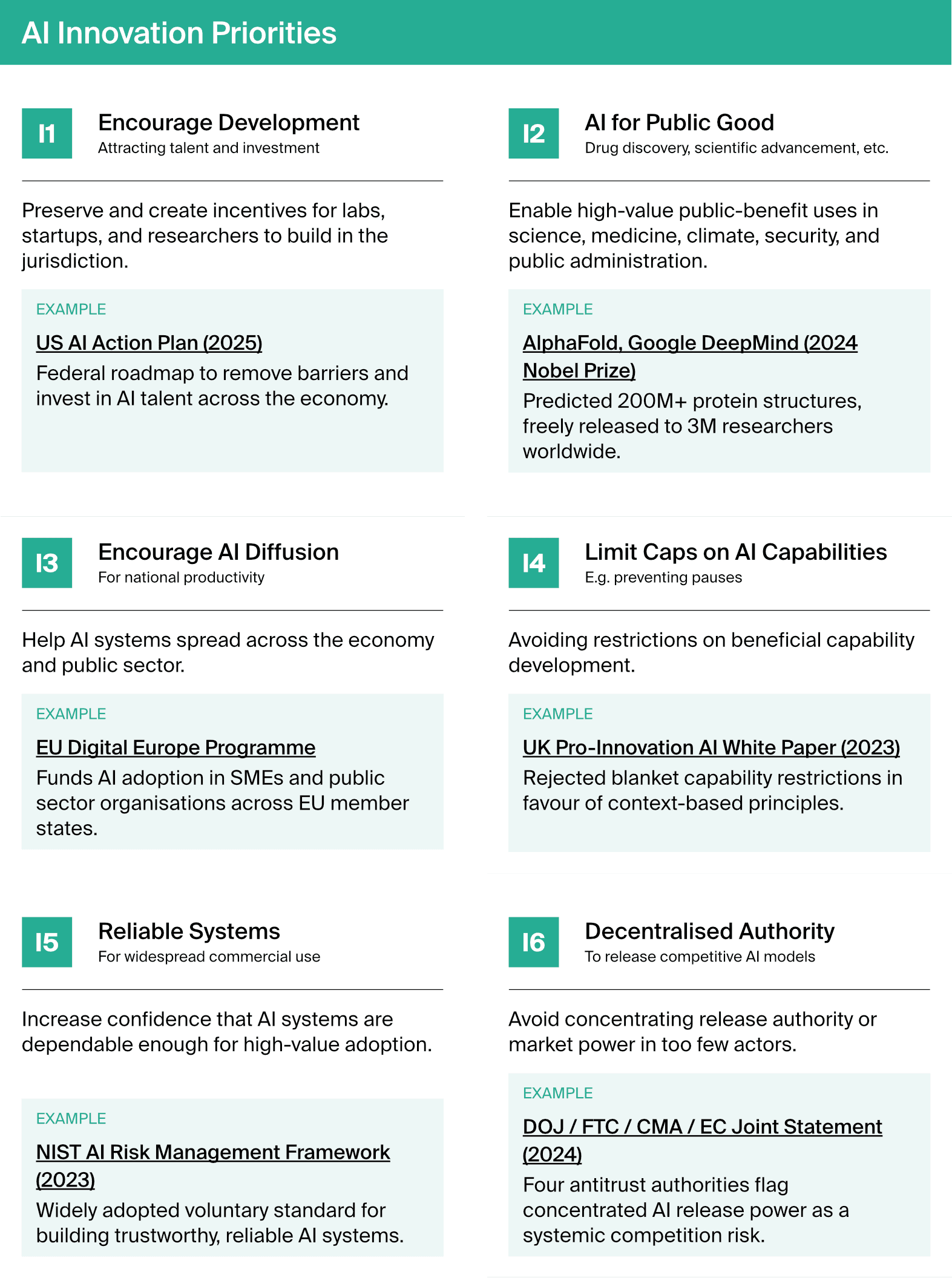
AI Readiness strategies should enable AI innovation. In this addendum, we present 6 Innovation Priorities for a thriving AI innovation ecosystem, based on expert consultations on the AROs framework.
Security interventions will impact different aspects of innovation in different ways: some security measures may support some aspects of innovation and undermine others, or have no impact at all. By distinguishing between different aspects of AI Innovation, we can better assess these trade-offs.
The Innovation Priorities are intended as a preliminary set of considerations to support discussion and analysis, rather than a definitive taxonomy of AI innovation. They are primarily for use in the forthcoming AI Readiness Case Studies, in which we will assess progress and gaps in innovation alongside AI readiness using these six priorities. More broadly, the current priorities may be a helpful heuristic for others to illustrate that AI innovation is not one single objective but several.
While innovation considerations are essential, the scope of AROs is focused on security, and the Innovation Priorities remain an addendum. However, we are conducting further research into interventions for AI Innovation and may develop this addendum into a fourth Pillar in the AROs Framework at a later time.
Who is this report for?
Primarily, this report is for researchers, advocates and funders to guide project prioritisation; AROs help thinking about how given interventions fits into a greater endgame, and how to identify gaps in existing approaches.
For example, our researchers at Convergence will use the AROs framework as a basis for case studies that identify gaps in US and EU AI preparedness, and propose interventions to patch these gaps. These case studies are meant to directly support policymakers with specific proposed actions.
The Interactive AROs framework may also be useful for a range of other stakeholders as an intuitive birds-eye view of the AI Security field, or as a framework to help in building detailed, holistic AI security strategies. For example:
Policymakers — Set strategic AI governance targets and indicators to hit for each Objective by 2030, 2035, etc.
Policy analysts — Assess a government’s AI preparedness by evaluating progress against each Objective, identifying implementation gaps, and comparing options for addressing them.
Legislators & political staff — Rapidly understand the landscape of proposed AI governance interventions, with links to supporting evidence and example legislative approaches.
Advocacy organisations — Keep resource prioritization up to date by identifying which Objectives are underserved, selecting interventions that advance them, and coordinating with groups pursuing complementary goals.
Research organisations — Identify promising research agendas, compare alternative pathways to the same Objective, and focus effort where evidence or policy proposals are weakest.
International organisations and standards bodies — Develop shared targets for AI preparedness, facilitate coordination across jurisdictions, and compare national or regional progress using AROs as a common framework.
Funders — Allocate funding across Objectives to identify neglected areas, and avoid concentrating resources on already well-covered interventions.
See the next section on how AROs relate to existing major AI security strategies for a discussion on applying AROs for project selection and prioritisation.
How do the AROs Support Existing Major AI Security Strategies?
A variety of strategies have been proposed for achieving a secure and beneficial future with AI. Some emphasize controlled development and deployment, others emphasize red lines, international regulation, defensive acceleration, moratoria, or secure-by-design systems.
Crucially, many of these strategies may be necessary but none of them are sufficient by themselves for preventing intolerable threats. The AROs framework is designed to support building comprehensive strategies. The framework can draw attention to what a given strategy leaves out, and whether those omissions are acceptable, fatal, or covered by some complementary efforts elsewhere. The AROs are not themselves a complete strategy. Rather, they are a tool to develop, examine, and stress-test AI security strategies.
The examples below introduce a series of proposed AI security strategies and briefly note how they can be mapped to the AROs framework. The point is not to endorse any particular strategy, but to show how AROs can support reasoning about what each strategy requires, what it explicitly aims to achieve, and what else would need to complement it for AI Readiness.
Controlled development and deployment
For example seen in Anthropic’s Responsible Scaling Policy, and GovAI’s Frontier AI Regulation.
Controlled-development approaches aim to keep advanced AI systems under meaningful human control by pairing technical security techniques with governance constraints on development and deployment. On this view, increases in model capability should be matched by progress in evaluations, alignment, interpretability, model security, oversight, and deployment safeguards.
The AROs Pillars 1 and 2 can support thinking about the range of relevant interventions for controlling development and deployment, whilePillar 3 highlights that additional societal resilience measures may be prudent to complement this approach.
Defensive acceleration
Seen in Vitalik Buterin’s My techno-optimism; Sandbrink, Hobbs, Swett, Dafoe, & Sandberg’s Differential technology development; and CLTR’s Defensive acceleration: the strategic pivot needed for UK biological resilience.
Defensive-acceleration approaches aim for a world in which defensive and security-enhancing uses of AI outpace offensive, destabilizing, or unsafe uses. The core idea is not simply to accelerate AI, but to differentially accelerate systems, institutions, and applications that strengthen control, resilience, security, and public protection.
AROs and the Innovation Priorities provide a framework for thinking in detail about combinations of sociotechnical levers that can accelerate defensive AI, as well as negotiate trade-offs between defence and acceleration.
Red lines
Seen in UNESCO’s International AI Red Lines, and The Future Society’s Global Red Lines for AI.
Red-lines approaches aim to define a limited set of unacceptable AI capabilities, uses, or deployment conditions, and to make those boundaries legible, credible, and enforceable. Rather than regulating all AI activity equally, they focus attention on the thresholds most likely to produce severe or irreversible harm.
The AROs framework can help identify the technical and governance prerequisites for defining and enforcing redlines, by highlighting relevant upstream Objectives (AROs 1-4), and providing resources on the measures that support them. It can also help assess what red lines need to achieve in practice, and identify complementary measures that may be needed where red lines cannot adequately address all 7 Objectives.
International regulation
Seen in IAPS’ Strategic Visions, OpenAI’s Governance of superintelligence, AI Futures Project’s AI 2040, and International Affairs’ Establishment of an international AI agency.
International-regulation approaches aim to create shared rules, institutions, and verification mechanisms for frontier AI development and deployment. These approaches vary in ambition: some imagine a strong global regulator, while others focus on harmonized national rules, international standards, joint evaluations, or treaty-based constraints.
AROs help clarify what an ideal international agreement needs to achieve. For example, an international regulator requires that standards exist (ARO 2), and needs the visibility (ARO 3), technical capacity (ARO 4) and mechanisms (ARO 5) to enforce them globally. AROs could also serve as a set of global targets as a basis for international cooperation.
The Case Studies will support identifying gaps in national AI readiness that an international institution can compensate for. For example, a bi-lateral US-China agreement may be sufficient to achieve Pillars 1 and 2, but societal resilience will remain a global issue. In this case, AROs could imply that an international organisation is well-suited to focus on preparing for international shocks from AI.
Global moratorium or capability cap
Seen in Future of Life Institute’s Pause Giant AI Experiments, the Statement on Superintelligence, and A Narrow Path.
Moratorium, capability-cap, and “pausing” approaches aim to prevent AI development from crossing dangerous thresholds until adequate security and governance conditions are in place. These approaches are especially relevant under assumptions that timelines are short, alignment is currently unsolved, or the consequences of premature deployment may be irreversible. These strategies vary in scope: some call for a temporary pause on training frontier models, while others call for more durable limits on particular capabilities or development pathways.
The AROs Framework and case studies could in the future make a strong case for an AI moratorium, if they produce credible findings that key governments are lagging far behind their own standard of AI readiness. By clarifying end goals, AROs support governments in setting time-bound targets: for example, if a government wants an auditing ecosystem by 2028, AROs highlight the prerequisite steps. Auditing by 2028 may depend on creating AI security standards by January 2027. If it becomes clear that these targets are impossible to achieve, while stakes of AI security failures become demonstrably higher, this would be an urgent, credible case for a moratorium.
Importantly, these targets could also define the point at which such a moratorium should be lifted, ensuring that the moratorium is responsive to the specific interests of the governments involved.
Lastly, the AROs provide an entry point to thinking about what kinds of interventions or developments would be required to define and enforce a moratorium (see Pillar 2).
Strategic control through advantage
Seen in the White House’s Winning the Race: America’s AI Action Plan and Leopold Aschenbrenner’s Situational Awareness.
Strategic control approaches aim to ensure that a relatively trustworthy actor, state, coalition, or institution has enough lead, leverage, and enforcement capacity to shape frontier AI development before less responsible actors can cause catastrophic harm. This may involve maintaining advantages in compute, model security, talent, evaluations, deployment channels, defensive applications, or legal authority. Some versions emphasize deterrence and strategic advantage; others emphasize centralized enforcement, sovereign capacity, or control over critical AI infrastructure.
AROs concerning control (measures in ARO 5) and government situational awareness (ARO 3), and the AI Innovation Priorities can guide strategies on what combinations of actions will ensure control and secure model weights, while also accelerating innovation.
Mutually Assured AI Malfunction (MAAIM)
Seen in Hendrycks et al. ‘s Superintelligence Strategy, AI Futures Project’s AI 2040, and Oscar Delaney’s Crucial Considerations in ASI Deterrence.
Mutually-Assured-AI-Malfunction approaches aim to establish a strategic equilibrium in which no actor can reliably achieve unilateral AI dominance. Rather than relying solely on agreements or restraint, these approaches seek to make attempts at racing toward superintelligence difficult, costly, and unlikely to succeed by ensuring that they can be detected, disrupted, or sabotaged by other capable actors. Measures taken by nations to improve deterrence, non-proliferation, and competitiveness are intended to produce a stable strategic environment in which catastrophic AI outcomes become less likely.
The AROs Framework provides guidance on what needs to be achieved during this stable period in the build up to ASI. The framework and the Innovation Priorities also highlight interventions to limit AI proliferation in support of a MAAIM regime while increasing AI competitiveness.
How do AROs Relate to Existing Frameworks?
The AROs framework’s unique contribution is the characterisation of AI readiness in terms of the 7 AROs, and the framework that structures AI security interventions around the AROs. By grouping interventions according to the Objectives they serve, and ordering them from upstream to downstream the framework supports reasoning about how different interventions contribute to the same Objective, and whether a jurisdiction is adequately prepared for powerful AI.
Existing frameworks generally provide detailed catalogues of interventions, risks, policies, or readiness indicators with various different scopes and levels of granularity. The AROs are intended to complement these resources by providing a framework for assessing when a combination of interventions is sufficient for an AI Security strategy.
Peregrine Report (2025) : Covers a broad range of 208 existing and novel proposals at a high level, with an emphasis on identifying opportunities for future work and discussion.
The AROs framework explicitly groups interventions by high-level objectives to support reasoning about interactions and priorities between interventions. However, the AROs framework only covers interventions that are well-discussed in the literature, while the Peregrine Report contributes additional, novel interventions from in-depth expert interviews to guide future work. The AROs Resource list can provide more detail on some interventions in the Peregrine Report.
MIT Risk Mitigation Database (2025): Extracts 831 AI risk mitigations from 13 sources and organises them into four categories, with a particular emphasis on organisational mitigations. It provides a highly information-dense catalogue of interventions.
Compared with the AROs Resource list, it offers greater granularity and groups interventions by mechanism, rather than by objective. AROs can complement the MIT database by providing an alternative structure that may support thinking on which interventions to pick and why.AI Readiness Index (2025): Quantitative indicators for a range of kinds of AI readiness. It goes into more detail than AROs on some AI Innovation Priorities, and offers specific indicators for quantifying readiness in each area.
The Index scores countries’ safety and security based on the enabling mechanisms they have in place (such as an AISI or a commitment to monitor AI), which are useful proxies for AI readiness. AROs can complement this framework as a tool for assessing adequacy of the mechanisms that are in place (e.g details about AISI mandate and funding, details of an AI monitoring regime).
Project GRASP (ongoing): Maps of tools, policies and technologies, structured as a tree that connects AI risks to potential solutions and research initiatives. Currently in beta.
Project GRASP is structured around risks, so it is useful for actors concerned with a specific risk area. It lends itself to local, risk-specific interventions. In contrast, AROs engage with the culmination and interaction of many risks, and are designed to support holistic, big-picture strategies that are largely risk-agnostic.
OECD.AI Policy Navigator (ongoing): Database of AI-related policies, governance initiatives, and regulatory developments from governments around the world. Intended as a searchable resource for comparing national AI governance approaches and tracking policy trends.
AROs emphasise existing expert proposals rather than existing policy, so AROs cast a wider net than the policy navigator in the interventions it presents. The Policy Navigator is a valuable complement to AROs for exploring examples of actual implementations in the wild, and for assessing the state of governments’ readiness based on their existing legislation. See also ETO AGORA.
A notable mention is the forthcoming book The AI Endgame, by Risto Uuk & Lode Lauwaert. The book will argue that “that no single solution will suffice — prevention must come first, defense-in-depth must follow, and we must act before it’s too late,” and presenting “a roadmap for the choices still open to us.”
Methodology
Featured in this report is the second iteration of the AROs framework. This version of AROs was created through a review of the interventions described in 83 sources. ~400 interventions were harmonised by hand into a shorter list of 45 intervention categories. These were then grouped by hand by common objectives, forming the 7 AROs. These objectives were further grouped under the 3 Pillars. The final product was developed in consideration of feedback from 33 experts at leading think tanks, US, UK, and EU government bodies, and frontier AI lab staff.
This entire process was iterative; below are the steps our team took in more detail:
AROs Version 1
1.1 We conducted a literature review of 56 sources that present overviews of recommended interventions for AI readiness. This includes sources from labs, governments, academia and civil society.
1.2. We gathered every intervention mentioned by these sources.
1.3. We described each intervention on a similar level of abstraction to enable meaningful comparisons. This entailed combining some interventions, and splitting others into two or more.
1.4. Through three iterations, we organized these interventions according to their underlying objectives, creating the first version of the AROs, grouped under the 3 Pillars.AROs Version 2
2.1. We held individual consultations with 33 leading experts in AI strategy and security, compiling feedback on the AROs version 1 structure, coherence and coverage.
2.2. We developed an LLM research pipeline, which helped us extract an additional 320 individual interventions from 27 additional sources. We used this to ensure the next version of AROs had extremely broad coverage. You can see the prompts we used and the raw outputs from the process.
2.3. As in the first literature review, these interventions were harmonised and grouped by hand, ensuring we could catch duplicates and hallucinations. While the LLM may have missed or misclassified some interventions from individual sources, the substantial overlap across sources and our manual harmonisation give us reasonable confidence that the final set of 45 interventions captures the vast majority of, if not all, distinct intervention types.
2.4. With close reference to expert feedback and the updated list of interventions, we developed the second version of AROs with iterative internal analysis.
We are continuing consultations with experts with an expanded formal consultation in progress to strengthen consensus on this framework, and update it if necessary. If you are an expert who has valuable feedback on our work, please contact Gwyn Glasser at gwyn.glasser@convergenceanalysis.org.
Design Choices, Values, and limitations
Below we raise some discussion points that have come up in our expert consultations:
The 3 Pillar Structure
We found that all interventions are naturally subservient to at least one of the three Pillars: either creating knowledge about how AI can be produced securely (Pillar 1), ensuring the required actors act appropriately on that knowledge (Pillar 2), or preparing for failures in either of these areas (Pillar 3). We found this grouping to the most concise and intuitive articulation of the highest level goals of AI security work. The three Pillars are also comprehensive by definition, providing a high-level scaffold for the AROs that will be robust to many possible futures.
Similar groupings are mirrored elsewhere in the literature, such as in BlueDot Impact’s AGI defence layers, the Swiss-cheese model of AI security, and in the International AI Safety report, which for example notes that “AI malfunction”, “misuse”, and “systemic impacts” are the three major categories of threats that must be addressed.
Current Limitations of AI Security Research
The AROs Framework builds directly on the fields of AI security and governance research, and is subject to limitations within those fields. Some well-known examples of limitations in these fields are:
There are significant, well described limitations in frontier AI alignment and evaluation.
Societal impacts are uncertain, given how novel and quickly-changing AI is. For example, it is difficult to measure impacts of AI on information operations or labor markets.
AI capabilities can change quickly; any measures that are sufficient today may be insufficient within 12 months or less.
Existing proposals are not exhaustive of all possible interventions. In the future, new interventions will be proposed, and the AROs interventions may become out of date, although we expect the Pillars and Objectives to remain stable.
In some cases, the AI Security field may not be mature enough to achieve the AROs using existing proposals. In the forthcoming case studies, we aim to highlight any such gaps in the field as areas for further research.
Specific thresholds for adequacy remain context-specific
We present 7 Objectives, but do not quantify thresholds for what adequacy will look like for each Objective. We leave this to the user to define, because different jurisdictions will have different concrete requirements and resources. In this way, the AROs Framework is descriptive of the AI security field, aiming to present a range of options side-by-side, rather than taking a strong stance on specific actions. Thus, the framework can be universally useful among many actors, and avoids engaging with object-level expert disagreements where possible.
In the upcoming case studies, we will propose more specific thresholds for each specific jurisdiction.
The AROs Framework does not prescribe a specific degree of international cooperation.
AROs are descriptive of the goals of the field of AI security (including calls for international coordination; see 5b & 5j in the AROs Framework). Different actors may have very different definitions of when an Objective is adequately achieved, or what interventions are appropriate to achieve it. As a result, while the AROs serve as a strategic framework that many stakeholders may agree with, and provide concrete tools that will be useful for many stakeholders, they do not imply that all stakeholders should take the same set of actions. Nor do they prescribe the degree to which stakeholders should cooperate. The AROs framework may support international coordination, as a set of 7 targets desired globally. We may also make specific recommendations around international coordination in case studies.
AI security and military AI
AROs are scoped for neutralising threats posed by AI systems, rather than military AI R&D. However, AROs support securing AI systems from misuse and are compatible with military AI R&D and other national security measures. Objectives 3, 4 and 6, and the Innovation Priorities may directly and indirectly support command, control and innovation in military use-cases.
Designed for Practical Use
We have prioritised broad, simple and intuitive coverage of the AI security space over creating a strict taxonomy with mutually exclusive categories. Some interventions will overlap and contribute to multiple Pillars and Objectives. These relationships are complex and diverse; it would be difficult to include them comprehensively, and would substantially increase the complexity of the framework. Instead, we will explore interactions between interventions in forthcoming case studies and interdependency tool. (See forthcoming work).
Some interventions may look similar, but pursue different Objectives. For example:
2e. Post-deployment monitoring practices covers making sure practices exist in labs for monitoring model behavior in the wild to support secure AI development;
3e. AI incident monitoring covers means for public actors to gather similar information to support governance and enforcement.
These interventions serve different Objectives, but relate closely, with 2e being upstream to 3e.
The AROs Framework Presents Existing Expert Opinions
We think most experts would find our overview unsurprising. That is to say, they have a strong idea of proposed interventions and how they all fit together.
We are confident that experts will nonetheless find AROs useful to develop or test their existing thinking around what readiness entails. Many experts tend to focus on their own area of expertise or interest, and it is a lot of work to also systematically consider all other areas of AI security and how they relate.
Experts also often keep their model of AI readiness private or internal. The AROs Framework aims to reduce duplication of work for others thinking about AI readiness.
Forthcoming work
The AROs framework and additional deliverables are under active development to better serve AI security decision makers.
Ongoing Work:
Case study: American AI Readiness
We are assessing the national AI readiness of the current US AI governance regime, using AROs. For each Objective, we will identify existing policies, remaining gaps, and concrete interventions that could address them, drawing on established proposals where available. We will also evaluate recommendations against the six Innovation Priorities, highlighting key trade-offs and synergies between AI security and innovation.
Case studies will also act as an example of how AROs can be used to support detailed strategic analysis, and demonstrate how others can use the AROs to develop comprehensive governance strategies.
Formal Consultation Round:
We are conducting an extended consultation round to engage twice as many experts (~60) as in previous consultation rounds. This will further stress-test the Framework, and strengthen consensus on what AI readiness entails.
Future Research Directions
Global priorities and needs may change quickly as the field changes. We have identified the following possible follow-up projects, which consulted experts considered valuable, and which we may pursue on the completion of our ongoing AROs projects.
Interactive interdependency tool: (illustrative mock-up here)
Developing an online tool mapping how specific interventions interact, with reference to real-world examples identified in the case study above. Insights into these dynamics ensure that a given combination of different policy actions is coherent, and does not involve any internal tension. We intend this tool to support policymakers, grantmakers, and researchers as they compare their options for combinations of interventions.Addressing US AI readiness Gaps:
If the US Case study identifies critical research gaps in US AI readiness, we may choose to focus our resources on addressing these via research, convening experts or supporting ongoing work elsewhere.EU Case studies:
The same as the US Case study, targeting the EU as a jurisdiction.AI Readiness indicators:
Developing measurable criteria for assessing progress towards each Objective. These indicators would not define fixed thresholds for readiness, but would be a concrete step towards quantifying AI readiness.Expanding the AI Innovation Priorities:
Conducting more research into the dimensions of AI innovation, to enable more precise analysis of how security interventions impact innovation.Mitigation-to-actor mapping:
Supplementing the AROs resource list with notes on which organisations or actors are best positioned to make contributions to each intervention, or are already contributing.
Feedback
If you have relevant expertise or institutional experience, and would like to provide feedback on any aspect of this work, please contact Gwyn Glasser at gwyn.glasser@convergenceanalysis.org.
Funding
We are currently seeking funding to support our ongoing and future work in this area. Interested funders or collaborators should contact funding@convergenceanalysis.org.
Acknowledgements
We would also like to especially thank the following for their feedback throughout developing the AROs: Alexander Saeri, Dewi Erwan, Duncan Cass-Beggs, Justin Bullock , Samuel Hammond, and Samuel Härgestam.
Report Link
Newsletter
Get research updates from Convergence
Leave us your contact info and we’ll share our latest research, partnerships, and projects as they're released.
You may opt out at any time. View our Privacy Policy.